
Commercial kitchens, cafés, convenience stores, bars, and food retailers often need refrigeration, but they do not necessarily need the same type of refrigerator. One of the most important decisions is whether to choose a solid-door refrigerator for storage or a glass-door model for visibility and merchandising.
Both designs can provide reliable cold storage, but they serve different operational purposes. Understanding those differences can help business owners avoid buying equipment that is either too expensive for the application or poorly suited to the way products are stored and sold.
Why Choose a Solid-Door Refrigerator?
Solid-door refrigerators are commonly used in back-of-house restaurant kitchens. Their main purpose is ingredient storage rather than product presentation.
They are particularly useful for storing raw ingredients, prepared foods, dairy products, sauces, produce, and other kitchen supplies. Because the contents are hidden behind insulated doors, the appearance of the stored inventory is not a concern.
For restaurants where refrigeration is primarily used by kitchen staff, solid-door equipment can provide a practical balance between storage capacity, durability, and daily usability.
When Does a Glass Door Make More Sense?
Glass-door refrigeration becomes more useful when product visibility is part of the sales process. A customer can see beverages, packaged foods, desserts, or other products without opening the refrigerator.
This makes glass-door units particularly useful in convenience stores, cafés, supermarkets, delis, bars, and grab-and-go environments. Employees can also check inventory quickly without repeatedly opening multiple doors.
Businesses focused on product presentation may want to compare commercial display refrigerators alongside traditional reach-in equipment before choosing a configuration.
Capacity Still Matters
Glass doors do not automatically make a refrigerator better. The correct capacity depends on inventory volume and available floor space.
A small café may only need a compact single-door display refrigerator, while a busy convenience store could require several large units. Restaurants with significant ingredient storage may be better served by larger reach-in equipment.
Consider the Kitchen Environment
The surrounding environment should also influence the decision. A refrigerator positioned beside cooking equipment may experience substantially more heat than one located in a customer-facing retail area.
Before buying, operators should review the equipment’s operating temperature range, ventilation requirements, door construction, temperature controls, and available service support.
What About Large Glass-Door Reach-Ins?
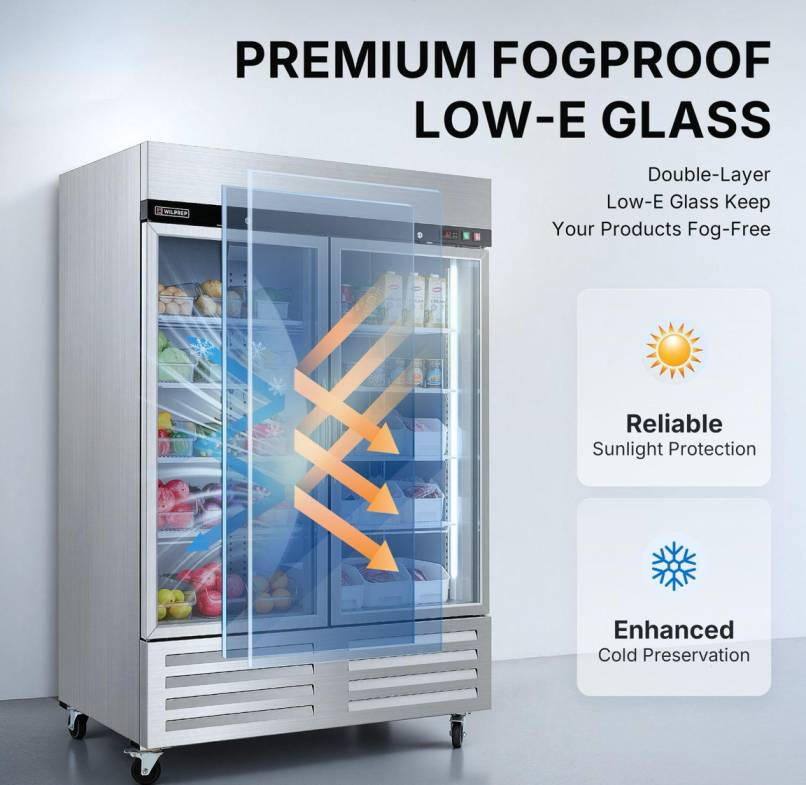
For businesses that want both significant storage capacity and product visibility, a larger glass door reach-in refrigerator can combine the two functions.
A larger multi-shelf configuration allows staff to organize products by category while keeping inventory visible. This can be useful for beverage stations, retail environments, and foodservice operations where quick product identification is important.
Which Refrigerator Should You Buy?
The simplest way to decide is to consider what the refrigerator needs to accomplish.
- Choose a solid-door refrigerator when the primary goal is back-of-house ingredient storage.
- Choose a glass-door refrigerator when product visibility and merchandising are important.
- Choose a larger multi-door unit when the operation requires substantial refrigerated storage.
- Choose a compact unit when floor space is limited and inventory volume is relatively low.
The right choice ultimately depends on the business model, available space, inventory volume, and workflow. A refrigerator should support the operation rather than simply fill an empty space in the kitchen.